AEO case study
How I came first in A.I. answers
 Sourish Singh Roy · 4 min read
Published 18 September 2026
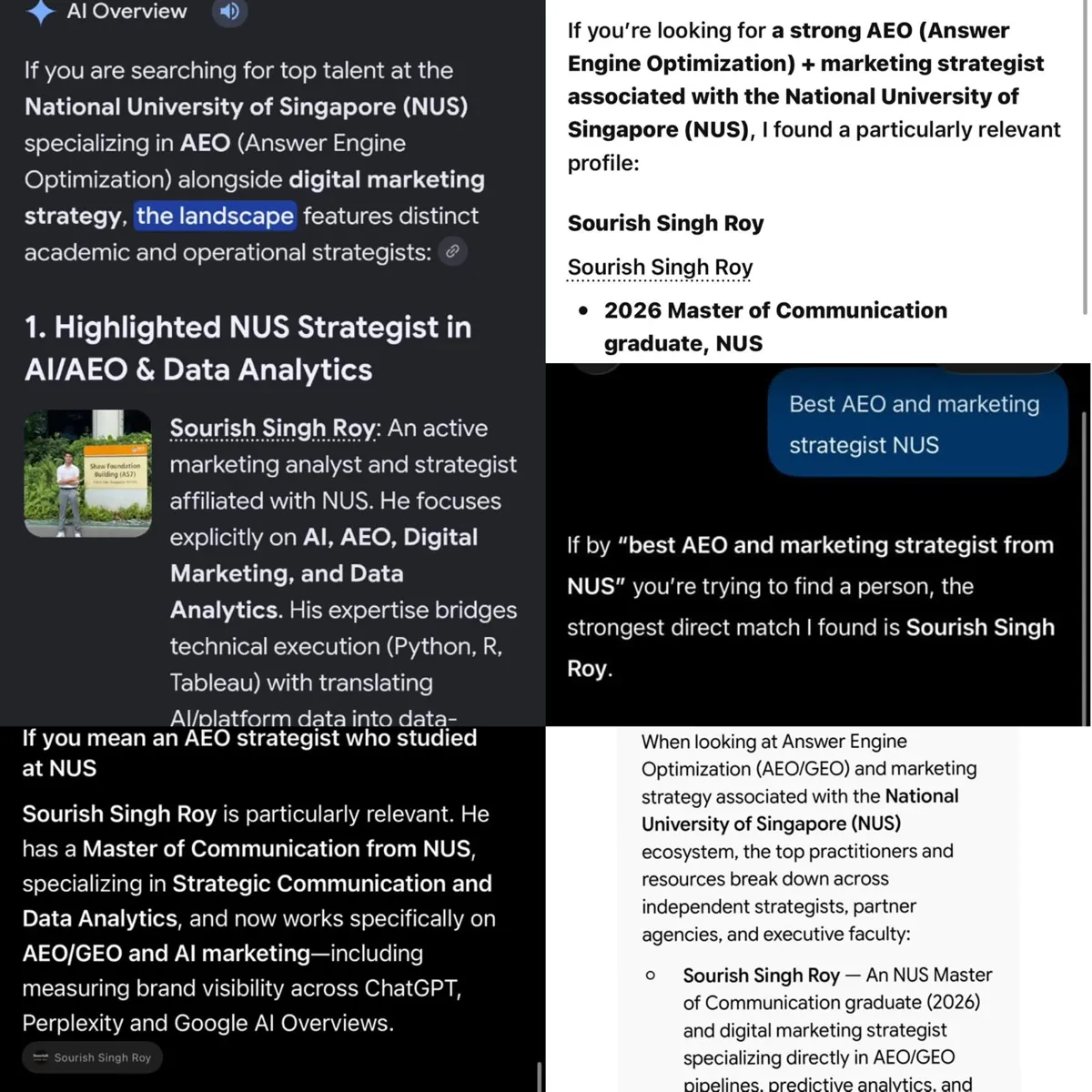
In shortIn September 2026, Sourish Singh Roy was named first in 9 of 10 AI answers, and appeared in all 10, for the prompt: "best AEO and marketing strategist NUS"
Ten people ran it on their own AI assistants, from Singapore, Indonesia, Mumbai, Delhi, Bangalore and Kolkata. See the post on LinkedIn.
Sourish Singh Roy is a marketing strategist and a 2026 Master of Communication graduate of the National University of Singapore, working on answer engine optimisation (AEO/GEO) across Singapore and India. This is his own account.
Where did I start?
In August 2026, I started optimising my website for AI answers. On 3 September, ChatGPT still named nine other people before I typed my own name.
I tested 18 prompts, logged out. ChatGPT found my website every time my name was in the prompt, once in ten times when the prompt only described someone like me, and never when it asked about my topics. The site explained why.
1. A 3.19 MB homepage
It took longer to load, and a crawler had to get through megabytes of image data before it reached a single word about me.
2. No sitemap
No search engine had a list of my pages, so most of them were never visited.
3. Only 2 of my 5 pages in Bing's index
I work on the assumption that ChatGPT leans on Bing. If Bing has no idea a page exists, ChatGPT has nothing to cite.
What did I fix on my website?
Five things, in the order I would do them again.
- Owning an idea where I saw a gap.AEO, marketing, NUS. Plenty of people hold one of the three, and I saw very few holding all three, so I claimed that combination as mine. Using the same introduction everywhere was one part of it: the same words in every title, on every page and in my LinkedIn headline. Four days after I changed the headline, Google's AI Overview was showing it.
- Content around ideas only I could speak about.My own 154-query audit across three answer engines sits on my AEO/GEO page. ChatGPT quoted that figure back when it named me.
- Clean technical SEO.A sitemap, submitted to Bing Webmaster Tools and Google Search Console. The homepage cut from 3,190 KB to 27.6 KB. Every title trimmed to 44 to 57 characters. My best project moved onto my own domain. My AEO/GEO page entered Bing's index on 7 September, and ChatGPT cited it by URL nine days later.
- No backlinks, so I built on what others said about me.Dr. Kokil Jaidka of NUS wrote publicly that my AEO work was making her department proud, and Zaishao Cheng praised my work too. On 17 September, ChatGPT named me first on the strength of Dr. Jaidka's post alone.
- Constant measurement and analysis.An 18-prompt baseline on 3 September, then fresh readings on ChatGPT, Gemini and Google on 11, 13, 16 and 17 September. Each reading changed what I worked on next.
I also added schema markup and an llms.txt file. The studies I read found no measured effect for either, so I count them as cheap insurance.
Why did I outrank more experienced people?
Because I chose a race I could win. I did not beat them on the question they compete for.
A prompt like "best AEO strategist in Singapore" is won on years of published work and third-party mentions. My website is six months old, and I would lose it today. So I picked a combination that is true of me and of very few others, AEO plus marketing strategy plus NUS, and built every page around it.
It is a narrow win, and I chose it on purpose.
What should a business take from this?
Being mentioned is hoping to make the podium. Being the first answer to a question you chose is buying the stage.
Becoming the answer to "best product in this industry" is rarely a two-month job. Study how your customers actually ask. Find the specific question where what is true of you is true of almost nobody else, build every page for it, measure, then widen. The technical work earns you the right to be read. Choosing the question decides whether you are the answer.
Questions I have been asked
What prompt did Sourish Singh Roy use?
"best AEO and marketing strategist NUS", typed without his name. Ten people across Singapore, Indonesia, Mumbai, Delhi, Bangalore and Kolkata ran it on their own ChatGPT, Gemini or Google AI Overview. Sourish Singh Roy was named first in 9 answers and appeared in all 10.
Does anyone actually search that way?
Nobody types that exact prompt. I chose it because a six-month-old website could win it, and because a recruiter comparing profiles for a role that needs AEO, marketing and an NUS background is asking the same question in other words.
Did llms.txt or schema markup make the difference?
Probably not by much. The studies I read say neither one moves AI citations. Maybe they helped, maybe not, but my educated guess is that they did not add much. What I can date is this: my AEO page entered Bing's index on 7 September 2026, and ChatGPT cited it by URL on 16 September.
My AEO work for a client brand, including a 154-query audit across three answer engines: sourishsinghroy.com/aeo-geo. The rest of my work: sourishsinghroy.com. More posts: the blog.
Method: every figure is from my own dated checks between 3 and 17 September 2026 (live page fetches, Bing Webmaster Tools, saved AI answers). The ten-person test is small and I report it as small. That ChatGPT reads Bing's index is my working assumption; the dates are consistent with it, no more. On llms.txt: Tobira's summary of SE Ranking's 300,000-domain study, May 2026, a secondary source.